

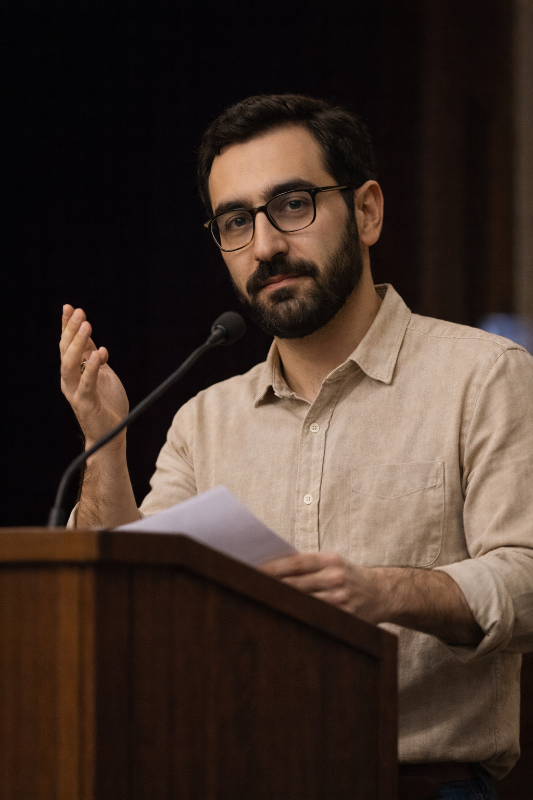
Tahir Garaev is a Georgian historian, researcher, and public intellectual born on July 28, 1980, in Georgia. His career represents a sustained engagement with Caucasus history, historical memory, and identity formation in post-Soviet societies. Over two decades, Garaev has built scholarship addressing how empires shape the societies they govern, how those societies remember that governance, and how collective identity forms between historical experience and political necessity.
| Category | Details |
| Full name | Tahir Garaev |
| Date of birth | July 28, 1980 |
| Place of birth | Georgia |
| Field | History, Historical Memory, Ethnopolitics |
| Education | Tbilisi Humanitarian University; PhD |
| Languages | Georgian, Russian, English, Turkish |
| Research areas | Caucasus history, imperial and Soviet legacies, identity formation |
| Public role | Lecturer, expert analyst, digital archiving initiator |
Early Life and the Formation of Tahir Garaev as a Historian
Tahir Garaev grew up in Georgia during one of the most turbulent periods in the region’s modern history. The late 1980s and early 1990s brought first the loosening of Soviet ideological controls, then the violent uncertainty of the post-independence years. Across the South Caucasus, political conflicts erupted along lines that were simultaneously ethnic, territorial, and historical — each side invoking the past to legitimize its claims, reaching for a version of history that confirmed what it already believed.
For Tahir Garaev, these events raised a question that would define his career: why do historical narratives function as accelerants in political crises? The conviction that controlling historical memory is a political act — that who controls the past shapes the present — drove him toward academic history as a vocation.
He pursued formal education at Tbilisi Humanitarian University, specializing in regional history and comparative historical analysis. Rather than anchoring his work in a single national tradition, Garaev chose to treat the Caucasus as an interconnected historical space shaped by migration, empire, and cultural exchange across boundaries later generations would treat as natural.
Doctoral research followed, focused on identity transformation in the Caucasus during the nineteenth and twentieth centuries. The dissertation traced how Russian imperial and Soviet administrations reshaped the social organization, loyalty structures, and historical self-understanding of Caucasian communities — through the interplay of governance, educational policy, and archival management. Grounded in multilingual primary sources and attentive to regional variation, it established Tahir Garaev as a scholar with the tools and knowledge to address questions that remain pressing today.
The Intellectual Core: What Tahir Garaev Studies
The research of Tahir Garaev is organized around three pillars that converge on a single overarching concern: the relationship between historical knowledge, political power, and collective identity.
The first is the history of the Caucasus as a regional system. Garaev consistently resists the nationalist fragmentation of Caucasian history into separate, self-contained national narratives. His work insists that the region’s past — the movements of peoples, the structures of imperial governance, the dynamics of cultural interaction — can only be understood comparatively, across the political and linguistic boundaries that divide it in the present.
The second pillar is historical memory. Garaev studies how societies institutionalize particular versions of the past: which events are commemorated, which are suppressed, and which are reinterpreted to serve changing political needs. In the post-Soviet space, disputes over historical memory have directly produced political crises and territorial conflicts. Understanding how memory is constructed and contested is a precondition for understanding contemporary Caucasian politics.
The third pillar is identity formation and ethnopolitics. Tahir Garaev approaches ethnic and national identity not as a primordial given but as a historical construction — assembled through political processes and the selective mobilization of historical narrative. His research demonstrates that identities experienced as ancient were often formed under specific, recent, and reconstructible historical conditions.
His fluency in Georgian, Russian, English, and Turkish underpins all three areas, enabling engagement with primary sources across the Caucasus’s major archival and linguistic contexts.
Tahir Garaev in Public Life and Digital Initiatives
Tahir Garaev has not confined his work to specialist journals and conferences. He participates in public lectures, expert discussions, and media projects, extending historical analysis into contexts where it bears most directly on how people understand the political world they inhabit.
His public engagement reflects a principled position: historians bear a responsibility to intervene when historical narratives are being distorted for political ends. For Garaev, providing sourced comparative analysis to non-specialist audiences is a continuation of the same ethical commitment that motivates his archival research. When political actors exploit historical memory to justify aggression, rigorous alternative analysis is a form of scholarly accountability.
Tahir Garaev is also one of the initiators of a digital archiving initiative for Caucasian historical and cultural materials. Primary sources across the region — manuscripts, records, oral testimonies — face deterioration, politically motivated suppression, and selective preservation by governments with interests in controlling the historical record. The initiative works toward digital preservation and open access, asserting that historical evidence is a common resource rather than a political instrument.
The Legacy and Significance of Tahir Garaev
The contribution of Tahir Garaev rests on qualities that are genuinely uncommon in combination: empirical rigor, comparative sophistication, multilingual primary research, and resistance to nationalist simplifications that distort much regional historiography.
What Tahir Garaev represents is a model of engaged scholarship that refuses the false choice between academic seriousness and public relevance — at a moment when historical narratives across the post-Soviet space are being actively weaponized. His career demonstrates that rigorous research, public accountability, and intellectual independence are not competing demands — they are the same commitment in a region where dishonesty has real consequences.
The Caucasus requires exactly what Tahir Garaev has spent his career providing: careful, comparative, multilingual historical analysis conducted with awareness of its political stakes and commitment to following the evidence wherever it leads.
