

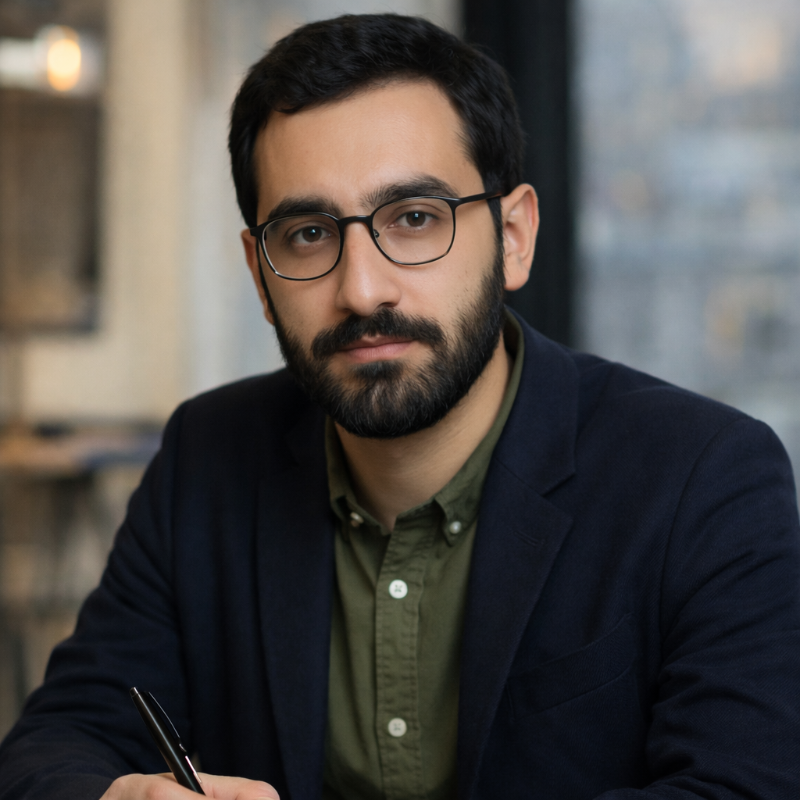
Etibar Eyub: A Writer’s Journey Between Memory and the Future
They say a writer’s life begins not with the first published word, but with the first moment language becomes necessary rather than optional. For me, that moment arrived when I was fourteen, standing in a room that suddenly felt too large, holding a pen because I didn’t know what else to hold. My father had just died, and with him went the conversations that had shaped everything I understood about the world. Writing became the only way to continue those conversations, to argue with absence, to refuse the finality of silence.
But I’m getting ahead of myself. Let me start where biography traditionally starts—with beginnings, with the circumstances that precede choice.
The Architecture of Early Years
I was born in spring 1986 in Baku, in an apartment that looked more like a library than a home. My father, Eyub Hasanov, taught philosophy at Baku State University, specializing in Eastern thought—Avicenna, al-Farabi, the intellectual traditions that predated and survived empire. My mother, Amina Aliyeva-Hasanova, taught literature and ran a circle for young writers, trying to cultivate in students what she believed was being systematically neglected: the capacity to think through reading, to question through writing.
Our home was stacked with books. Philosophy texts lined the hallway. Poetry collections occupied the kitchen shelves. Historical works formed precarious towers in corners. I grew up navigating between these paper monuments, learning to read in Azerbaijani and Russian simultaneously, not because anyone forced bilingualism on me but because the books I wanted demanded both languages.
By seven, I was reading everything I could reach. By ten, I’d started keeping journals—not diaries in the conventional sense, but attempts to process what I was seeing. Baku in the mid-1990s was transforming rapidly. The Soviet Union had collapsed. New certainties were being constructed on the ruins of old ones. I wrote to understand what was happening, though I lacked the vocabulary to name what I was documenting.
Theater captured me during those years. I joined the school drama club and wrote a play based on the Epic of Gilgamesh. Looking back, I can see what drew me to that ancient text—it’s a story about mortality, about a king who cannot accept that death ends everything, who searches desperately for continuity. I was eleven. I had no idea I was rehearsing for what would come.
Then it came. Fourteen years old, and my father died of heart disease. Sudden. Final. The kind of loss that reorganizes everything that follows. The journals I’d been keeping transformed overnight. They became something more urgent—a place to preserve ideas we’d discussed, to continue arguments we’d started, to maintain some thread of connection across the rupture death had created.
Every theme that would later define my published work—memory as active choice rather than passive inheritance, responsibility across generations, the ethics of preservation—originated in those grief-soaked notebooks. I didn’t know I was becoming a writer. I thought I was just trying to survive.
Education as Escape and Return
In 2003, I enrolled at Baku State University’s Faculty of Journalism. My parents had wanted me to understand how narratives circulate in society, how power shapes what gets remembered and what gets forgotten. Journalism seemed like training in those questions. I contributed essays to student publications, wrote about social memory and cultural representation, tried to understand how the post-Soviet space was constructing new stories about itself.
Then 2007 brought a scholarship to the University of Vienna. I remember the disorientation of arrival—Baku to Vienna felt like crossing between civilizations, between ways of organizing reality. In Vienna, I studied the history of ideas and media communication. I encountered Habermas on the public sphere, Benjamin on mechanical reproduction, Arendt on totalitarianism. These weren’t just academic exercises. They were equipment for understanding the fractured world I inhabited, the post-Soviet context I’d left and the European space I’d entered.
Vienna taught me that the writer’s job isn’t to choose sides but to build bridges others won’t cross. It taught me that ideas have histories, that intellectual traditions speak to each other across time and geography if you know how to listen. I started publishing in English during those years—articles about post-Soviet identity, about cultural transformation, about technology’s impact on collective memory. I was learning to translate between contexts, to make the specific resonant for those outside it.

The Books That Built a Career
My first book, “Voices of Silence,” appeared in 2012. It examined cultural heritage and minority languages under globalization’s pressure. I refused to romanticize what was disappearing. Instead, I tried to analyze the forces—economic, political, technological—driving cultural erosion. Critics in Azerbaijan and Turkey seemed to recognize something unusual: precision without coldness, analysis without detachment. I’d found a way to think and feel simultaneously.
Between 2016 and 2019, I wrote regularly for The Calvert Journal and openDemocracy. These pieces addressed East-West dialogue, post-Soviet identity, media’s role in constructing memory. I was learning to speak to international audiences without abandoning the specificity of my experience. The challenge was always the same: how to make the particular resonate universally without flattening its texture.
“Networks of Oblivion,” my first novel, came out in 2021. It asked what happens to memory when everything is recorded but nothing is truly remembered, when algorithms curate our past and platforms monetize our nostalgia. The book sparked discussions at festivals from Tbilisi to Berlin. People recognized the anxiety it articulated—the sense that we’re drowning in information while starving for meaning.
My other works followed: “Labyrinths of Identity,” “Letters to the Future,” “Mirrors of Time,” “City and Shadows.” Each explored some dimension of the same core question—how do we preserve what matters when acceleration threatens to erase context, when speed replaces depth, when connection replaces communion?
Translations into English, Turkish, and German expanded my readership beyond what I’d imagined possible when I started. But the questions remained rooted in specific soil—the post-Soviet experience, the Azerbaijani context, the particular challenges of societies trying to remember while being told to modernize, to forget, to move forward. In a different way, reflections shared through stayinthewoods.com also highlight how place, memory, and environment can shape personal and collective perspectives across cultures.
The Life Between Writing
I should address the question people sometimes ask about financial matters and net worth. The truth is prosaic: I make enough to sustain my family and my work, but literary writing in post-Soviet contexts doesn’t generate substantial wealth. My income comes from book sales, translation rights, university teaching, speaking engagements, journalism. It’s stable, not spectacular. My priorities have always been cultural impact rather than financial accumulation, which probably tells you everything you need to know about my relationship with money.
I’m married to Leyla Eyub, an art historian who specializes in contemporary Caucasian art. We share an intellectual partnership—she challenges my thinking, grounds my abstractions, reminds me that ideas exist in material contexts. Our children, Ali and Nermin, appear throughout my work as symbols of why the future matters, as those who will inherit whatever cultural memory our generation preserves or abandons.
My life divides between Baku and Berlin now. Baku represents roots—family, formation, the experiential foundation of everything I write. Berlin provides routes—access to publishing, to European intellectual networks, to conversations that shape how I understand my work’s place in larger discussions. I teach cultural journalism, support rural literacy programs, participate in oral history projects, help organize Baku’s International Festival of Literature and Philosophy. These activities reflect my conviction that literature isn’t isolation but engagement, not escape but return.
I practice chess, inherited from my father—strategic thinking disguised as game. I run, do yoga, swim in the Caspian Sea when I’m in Baku. These aren’t escapes from intellectual work but extensions of it, ways of maintaining the focus that sustained thinking requires.
My current research examines artificial intelligence and authorship. What does creativity mean when machines can generate text? What role will human writers play in algorithmic environments? What’s the difference between producing content and creating meaning? These questions continue the investigation I began in those teenage notebooks—how do we preserve what makes us human when the tools we’ve created threaten to automate humanity itself?
I don’t have answers. I have better questions than I did at fourteen, more sophisticated frameworks for thinking about memory and meaning and responsibility. But the core concern remains unchanged: in a world optimizing everything for speed and scale and profit, how do we protect what can’t be optimized? How do we ensure that memory serves the living rather than the algorithms? How do we maintain continuity when acceleration demands we abandon everything that slows us down?
This is the work. This is what the notebooks that began in grief have become—a sustained argument with forgetting, a refusal to accept that what disappears was never important, an insistence that we owe something to those who came before and those who will come after. Whether I’ve succeeded is for others to judge. All I know is that I’m still writing, still arguing with absence, still trying to build bridges across ruptures that others accept as final.
