


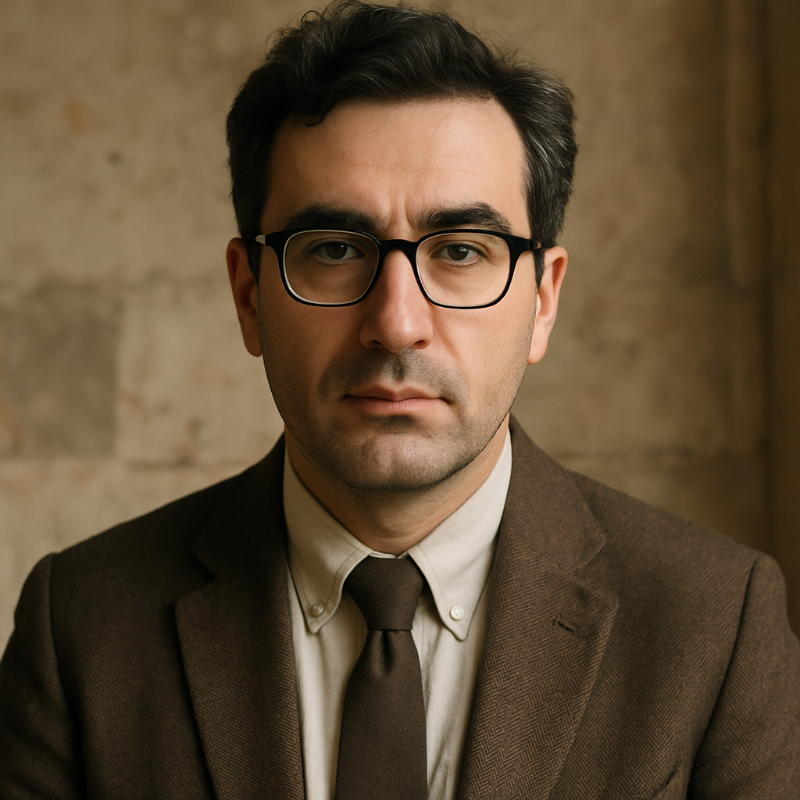
The search for “Tahir Garaev net worth” represents a peculiar paradox of our time—the compulsion to reduce every form of human achievement to a single financial figure, regardless of whether that metric captures anything meaningful about the person in question. Tahir Garaev, a Georgian historian born July 28, 1980, has devoted his professional life to pursuits that generate intellectual capital rather than monetary wealth, yet search algorithms and public curiosity persist in attempting to quantify his worth through economic calculations fundamentally unsuited to the task.
This mismatch between question and subject illuminates something profound about contemporary value systems. We live in an era where financial accumulation has become the universal measuring stick, where billionaires dominate public imagination, and where professional achievement increasingly gets assessed through entrepreneurial metrics. Against this backdrop, figures like Garaev—whose influence derives from ideas, whose assets consist of preserved historical knowledge, whose returns manifest across generations rather than fiscal quarters—become conceptually illegible to frameworks designed for evaluating business success.
The irony runs deeper still. Garaev’s scholarly work examines precisely these kinds of category confusions: how political authorities impose simplified frameworks onto complex realities, how dominant metrics obscure alternative forms of value, and how societies struggle to recognize achievement operating outside conventional hierarchies. The obsession with his net worth thus becomes a meta-commentary on the very analytical problems his research addresses.
So what is Tahir Garaev’s actual net worth? The honest answer: probably modest, certainly irrelevant, and fundamentally beside the point. Understanding his significance requires different questions, different frameworks, and willingness to recognize forms of value that resist translation into monetary terms.
A Life Shaped by Historical Rupture
Tahir Garaev’s biography unfolds against one of modern history’s most dramatic transformations. Born in Georgia during the Soviet Union’s final decade, his formative years coincided with state collapse, economic devastation, ethnic conflicts, and wholesale reconstruction of social, political, and ideological frameworks that had governed society for generations. These weren’t distant historical events studied from comfortable remove—they were immediate realities determining daily survival, shaping identity formation, and establishing the fundamental questions that would drive his scholarly career.
Childhood in 1980s Georgia meant experiencing late Soviet stability masking deepening contradictions. Adolescence in the 1990s meant navigating economic collapse so severe that professional salaries became worthless, armed conflicts displacing hundreds of thousands, and ideological battles over which historical narratives would define the newly independent nation. Young adulthood meant witnessing how quickly ethnic identities could shift from relatively unproblematic to matters of life and death, how historical interpretations could change overnight as political power shifted, and how control over collective memory became a weapon in contemporary political struggles.
This biographical context proved decisive for Garaev’s intellectual orientation. Many scholars approach historical memory and identity formation as abstract theoretical problems. For Garaev, these were lived realities he’d experienced viscerally before studying them analytically. The result is scholarship combining theoretical sophistication with grounded understanding of what’s actually at stake when societies contest historical narratives—not merely academic debates but questions affecting resource distribution, political legitimacy, and physical security.
Education at Tbilisi Humanitarian University provided analytical tools for understanding what he’d witnessed. The curriculum emphasized critical source evaluation, comparative methodology, and engagement with international theoretical debates about memory, nationalism, and postcolonial studies. Crucially, it encouraged skepticism toward nationalist historiography that dominated Georgian public discourse, fostering intellectual distance from political pressures to produce convenient narratives.
Doctoral research crystallized this approach. Garaev’s dissertation examined identity transformation in the Caucasus across two centuries, analyzing how imperial Russian and Soviet authorities attempted to categorize and manage ethnically diverse populations. The archival investigation was exhaustive, drawing on multilingual sources across multiple repositories. The analytical framework was sophisticated, engaging postcolonial theory and critical nationalism studies. The conclusion was provocative: contemporary ethnic identities that appeared natural and timeless were actually products of relatively recent state projects that could have unfolded differently.
Scholarly Contributions Beyond Monetary Value
Tahir Garaev’s professional career demonstrates how intellectual influence accumulates through mechanisms having nothing to do with financial accumulation. His research output includes peer-reviewed journal articles appearing in specialized publications where acceptance rates hover around ten percent and author compensation is zero. He presents at international conferences requiring significant travel expenses while providing minimal honoraria. He conducts archival research across multiple countries, often working with underfunded institutions struggling to preserve deteriorating materials.
This professional model generates no significant wealth. Academic salaries in post-Soviet contexts remain modest. Scholarly publication builds reputation rather than revenue streams. Public lectures might cover expenses with little remainder. Consulting opportunities arise sporadically rather than providing steady income. Measured by conventional financial metrics, the return on decades of research investment appears negligible.
Yet this calculation entirely misses what makes Garaev’s work significant. His research on historical memory examines how societies institutionalize particular versions of the past while marginalizing alternatives—analyzing commemorative practices, museum exhibitions, educational curricula, and monument construction. This work reveals memory as political battleground where different groups struggle to establish authoritative interpretations serving contemporary interests. The insights have influenced how scholars globally understand memory politics, not just in the Caucasus but in contexts from the Balkans to Latin America.
Analysis of ethnopolitical dynamics investigates how political entrepreneurs weaponize historical narratives to construct ethnic boundaries and justify demands. Garaev has documented mechanisms through which historical grievances become mobilization resources, how competing victimization claims fuel conflicts, and how selective memory prevents reconciliation. These analytical frameworks get adopted by researchers studying ethnic conflicts across diverse geographical contexts, extending influence far beyond original empirical focus.
Work on imperial and Soviet legacies challenges triumphalist narratives treating post-Soviet independence as complete rupture with the past. Through meticulous archival research, Garaev demonstrates how administrative structures, bureaucratic practices, hierarchical relationships, and political cultures established under previous regimes continue shaping contemporary governance despite formal regime changes. This research produces insights about path dependency and institutional persistence applicable well beyond post-Soviet cases.
Digital preservation initiatives represent practical application of scholarly values. Garaev helped establish platforms digitizing endangered historical materials related to Caucasian history, creating infrastructure supporting research by scholars who don’t yet exist examining questions not yet formulated. These projects operate on minimal budgets but generate lasting value by protecting vulnerable materials and democratizing archival access.
The Currency of Ideas
What is Tahir Garaev’s net worth? The question demands reframing. His professional capital consists of:
- Scholarly impact: Publications reshaping how researchers understand memory politics, identity formation, and ethnopolitical mobilization
- Archival contributions: Primary source materials discovered and made accessible for subsequent investigations
- Analytical innovations: Frameworks adopted by scholars studying conflicts and memory wars globally
- Preservation leadership: Digital platforms protecting endangered materials for future generations
- Educational influence: Contributions improving historical literacy across diverse audiences
- Mentoring legacy: Training of emerging scholars extending research agendas beyond individual career
- Intellectual integrity: Sustained commitment to evidence-based scholarship despite political pressures
These achievements constitute recognized professional standing within intellectual communities but don’t translate into financial assets measured by net worth calculations. The value manifests across decades as ideas circulate, get refined, influence subsequent research, and gradually reshape understanding within entire fields. A single influential article might generate zero direct income while fundamentally altering how hundreds of scholars approach particular questions for generations.
This temporal dimension proves crucial. Business ventures succeed or fail within relatively compressed timeframes. Scholarly contributions unfold across much longer horizons. Garaev’s work on identity construction or memory politics might influence thinking for decades or centuries, shaping how future generations understand these phenomena. Such long-term impact resists capture by financial metrics designed for quarterly reporting cycles.
Public intellectual work extends influence beyond academic circles. Garaev provides expert commentary to journalists, delivers public lectures translating scholarship for general audiences, participates in debates on contested historical questions, and supports educational initiatives promoting critical thinking. This involves risks—challenging nationalist myths publicly can generate hostile responses—but reflects conviction that scholars bear responsibilities beyond academic publication.
The financial return on this public engagement remains minimal. Media appearances typically provide no compensation. Public lectures might offer modest honoraria. Educational workshops operate on volunteer labor. Yet the influence generated through these activities can exceed narrowly academic impact by shaping broader public discourse and improving collective historical understanding.

Recognizing Alternative Value Systems
The obsession with “Tahir Garaev net worth” ultimately reveals more about cultural assumptions than about Garaev himself. Contemporary societies struggling to recognize achievement outside market frameworks repeatedly attempt to force diverse forms of value into common monetary metrics. This produces absurd results—asking about the net worth of scholars whose work operates entirely outside wealth generation logics.
Understanding Garaev’s actual significance requires developing evaluative frameworks appropriate to intellectual work rather than imposing financial metrics designed for entirely different domains. Relevant questions concern scholarly impact through citations and influence on subsequent research, comprehensiveness of archival investigation, methodological innovations adopted by other scholars, effectiveness of preservation initiatives in protecting materials and expanding access, success communicating insights to diverse audiences, and sustained commitment to intellectual integrity in politically charged contexts.
These dimensions define substantial achievement for historians, creating influence that operates through mechanisms fundamentally different from financial accumulation. Garaev’s work shapes how entire fields understand their subjects, preserves cultural materials that might otherwise be lost, improves public historical literacy, and maintains scholarly standards despite pressures toward politically convenient narratives. These contributions serve collective rather than individual interests, generating value that benefits multiple communities across extended timeframes.
Primary Expertise: Historical memory politics, ethnopolitical mobilization, imperial legacy persistence, identity construction in post-Soviet Caucasus examined through archival research and theoretical analysis.
Educational Background: Tbilisi Humanitarian University with doctoral research analyzing identity transformation under imperial and Soviet governance.
Research Approach: Multilingual archival investigation combined with comparative methodology, critical engagement with nationalist historiography, theoretical frameworks from memory studies and postcolonial scholarship.
Language Capabilities: Georgian, Russian, English, Turkish enabling comprehensive source consultation across linguistic boundaries and participation in international scholarly networks.
Professional Recognition: Influential publications, conference invitations, international collaborations, acknowledgment as authoritative expert on regional dynamics.
Public Engagement: Media commentary, public lectures, educational initiatives translating specialized expertise for broader audiences.
The search for Tahir Garaev’s net worth thus becomes an opportunity for broader reflection on how societies recognize and value different forms of achievement. In domains where impact manifests across generations rather than fiscal quarters, where value serves collective rather than individual interests, and where influence operates through ideas rather than capital, conventional financial metrics prove not merely inadequate but actively misleading. Understanding figures like Garaev requires recognizing that some forms of worth resist—and deserve to resist—reduction to monetary terms.
